We Like Humans
Host training.
Six people, one table, ninety minutes.
Say who you are and how many gatherings you have hosted. Then the honest
version: the first one you hosted was a bit of a mess and it worked
anyway, because the format does most of the job.
What we ask of you: warmth, attention, and a couple of hours. You do not
need to be an extrovert or an expert.
Overview
What we'll cover.
The mission. Why any of this matters.The theories. Why the format is shaped this way.Before the gathering. What to set up.Running it. Step by step, including what goes wrong.Closing and follow-up. The part most people skip.
Roughly fifteen minutes on the mission and the theories, then the rest of
the time on the evening itself, in the order it happens.
They do not need to memorise anything. The whole job fits on one line and
we get to it at the end.
We like humans .
Our anthropology: every human has inherent worth, irrespective of their
accomplishments.
Start here, because everything else is downstream of it.
An anthropology is a working answer to the question "what is a human
being, and where does their worth come from". Everyone has one, usually
unexamined. Ours is that worth is conferred, not earned. Not humanity in
aggregate: each person, individually, including the ones who will never be
impressive.
It sits entirely outside status, output and usefulness, which is why no
layoff and no machine can touch it.
The compressed version, and the line to carry into the room: make people
feel SEEN, HEARD AND LOVED. We come back to it twice more.
The problem
For most people, life will become harder than ever in the next few decades.
"Along with those wonderful things comes some scary things, and I
don't think people are putting enough work into how we can mitigate
those scary things."
Geoffrey Hinton , Nobel laureate, 2026
AI is coming for a large share of the work people locate their dignity in.
Whatever you think of the timelines, the next twenty years will move more
people between roles, cities and identities than the last fifty.
Hinton's other line, if you want something concrete: in a few years it
will do software engineering projects that are months long, "and then
there'll be very few people needed". He has gone from optimism about job
creation to warning about massive unemployment, and he is not selling
anything.
A caution if somebody quotes the famous numbers back at you. Dario
Amodei's "half of entry-level white-collar jobs in five years" and Sam
Altman's similar warnings were both softened during 2026 as their
companies approached IPOs. Do not lean on those two. Hinton has not walked
anything back, which is why he is the one on the slide.
Say the honest version: nobody knows the timeline. What we do know is that
when people lose the work they located their worth in, they need other
humans more, not fewer.
The problem
But we're becoming more disconnected .
6 hrs
spent alone each day - up 50% since 2010.
American Time Use Survey, 2023
Between 2014 and 2019, the time Americans spent alone rose by more
than it did during the pandemic.
The isolation was not lockdown. It arrived with the phone.
The freshest numbers, and they are worse than the older ones.
Young Americans spent about four hours a day alone in 2010. By 2023 it was
six. And socialising across everyone is down to 35 minutes a day in 2025
from 41 a decade earlier. For 15 to 24 year olds it roughly halved, from an
hour to 35 minutes.
Then the quote, which is the one that lands: between 2014 and 2019, before
anybody had heard of lockdowns, time spent alone rose by MORE than it later
did during the pandemic. That is the smartphone window, not the pandemic.
Putnam saw the beginning of this in the 1960s and named the causes:
television, sprawl, the pressure of time and money. Every one of them was
something more convenient than a person.
Which is the pattern. Feeds instead of friends, delivery instead of a
market, and now a synthetic companion instead of a difficult conversation.
Each is reasonable on its own and each is a substitute. Substitutes are
frictionless by design, which is exactly what makes them deadening,
because humans grow by friction.
A gathering is engineered friction. Unlikeminded, anticurated,
inconvenient, buy your own coffee.
Social stupidity
Platforms turned communal problems into individual problems.
Lonely? Network more.
"Carry one another's burdens" was never addressed to the burdened.
Modernity individualised every communal failure and billed it to the
person suffering it. That is not only unkind, it is irrational, and the
platforms finished the job: they let a whole civilisation feel connected
while carrying nobody.
Which is what you are undoing at a table of six. When somebody finally
admits they would like a friend, they are handing over a burden the rest of
us were always supposed to be carrying.
Our mission
Maximise social velocity .
you
the person you
should meet
Today
you
We Like Humans
Tech gets you 90% of the way - generosity does the rest.
Definition first: the speed and ease with which people reach the humans
they really should meet.
Then the picture, and the point is the two different lines on the right.
Today, you can only reach the people adjacent to you. The person who could
change your year is four or five hops away, which in practice means
unreachable, because nobody walks a chain of five introductions. You do not
even know they exist.
What we do is hop you to somebody who already knows them. That dashed line
is the machine, and it is the boring ninety percent: reading every ask,
remembering every name, finding the route.
The last link is solid, and a human makes it. Somebody has to decide to
introduce you, and want to. We never touch that part. The Fairy Godmother
gets you to the ball; she does not make the prince fall in love.
Measured two ways, and hosts get asked this. Reach: of all the needs a
person has, what share ever find their person. Latency: from the need
existing to sitting across from them, how long.
And what it is NOT: the number of encounters. Maximising meetings gives you
networking events, which is the thing we are replacing.
How
Our magic formula.
One
Small gatherings
Two to ten people. Never bigger than one conversation.
Two
Two questions
"What's your life story?"
Three
Fairy Godmothers
Personal superconnectors who understand your goals and find the people
you need to meet.
Press right three times. One card at a time.
Small gatherings, because a conversation caps out at about four people and
a room of forty is ten conversations you have to audition for.
Two questions, and the order matters. The life story earns the right to ask
the second one. Ask "how can I help you" cold and you get a warm nothing;
ask it after forty minutes of somebody's actual life and you get the truth.
And the second question is what changes the room: if everybody arrives
pushing their agenda we find each other annoying. Generosity is not a
personality type, it is a room with the right question in it.
Fairy Godmothers, because one table can only hold six people.
The division of labour that matters most to you: the machine does the
ninety percent that is logistics. It must never touch the ten percent that
is chemistry, generosity, courage and love. That ten percent is your job,
and we cannot automate you.
02
Part two
The theories.
The network science that underpins the formula.
Six findings. You do not have to remember any of them to host well, and we
tell you which bits to repeat at the table later.
Theory 01 · Dunbar, 1995
Ideal table size: 4 .
(We currently aim for 6).
one conversation
two conversations
Robin Dunbar and two colleagues stood around in bars and receptions and
counted how many people were in each conversation. The answer came back at
about four. Add a fifth and the group does not get bigger, it splits.
It is plumbing, not manners: how far a speaking voice carries, and how many
other people's minds you can hold in your head while also thinking of
something to say.
So why do we aim for six? Because a four-person table dies if one person
cancels, and a good host can hold six in one conversation. Six is the
compromise between the research and the no-show rate. Eight is the absolute
ceiling and it is already hard.
What it changes for you: your table is ONE conversation, and keeping it that
way is most of the job.
Second finding worth mentioning: Cheek and Buss, 1981. Shyness and
sociability are separate traits. Someone can badly want the company and
still dread the door. That is the most common person at our tables.
Theory 02 · Granovetter 1973, Rajkumar 2022
Weak ties carry the opportunities.
Though not the very weakest.
best friend
met twice
stranger
jobs found
Be precise about who said what, because the two findings are fifty years
apart.
Granovetter, 1973: your close friends know what you know. They read what you
read and have already told you about every opening they heard of.
Acquaintances live somewhere else socially, and that is where the new
information is. His claim was essentially "weaker is better".
Rajkumar and colleagues, Science, 2022: randomised experiments on
LinkedIn's People You May Know, 20 million people over five years, 2 billion
new ties, 600,000 new jobs. The relationship turned out to be an inverted U.
Moderately weak ties do the most work, the strongest ties help LEAST, and
the very weakest are less useful than moderately weak ones. Hence the shape:
low at your best friend, peaking at somebody you met twice, settling above
where it started.
One honest wrinkle: measured by messages exchanged rather than mutual
connections, the weakest ties looked best. The shape depends on how you
measure strength.
What it changes for you: the value is not in tonight. It is in the third and
fourth meeting. Getting people to say who they want to see again, before
they leave your table, is worth more than any single conversation you
facilitate.
Theory 03 · Burt, 1992
The value sits in the gap between groups.
the bridge
local hub
local hub
Between two crowds that never speak to each other there is a gap. Burt
called it a structural hole, and the person standing in it gets paid more,
promoted earlier, and rated as having better ideas. Not because they are
cleverer. Because an idea that is old news in one world is a revelation in
the next one over.
Now use the two clay nodes, because this is the point most people miss.
Those are the local hubs: the person everybody in their crowd knows, the
most connected in the room. They have MORE relationships than the bridge
does, and almost no new information, because everything they hear has
already been round their own crowd.
So popularity and usefulness are not the same thing. You do not need to be
an extrovert to be valuable here. You need to be in an unusual position.
The companion finding is the annoying one. Casciaro, Gino and Kouchaki:
networking deliberately for gain makes people feel physically dirty, and the
more power you already have, the less dirty it feels. The people who need
the bridge most are the ones most repelled by building it.
What it changes for you: resist the urge to curate a sensible table.
Theory 03, continued
It's easier (and more profitable) to be a bridge than an influencer .
1,200
crowds in Singapore
720,000
bridges needed
4 crowds, 6 bridges
The arithmetic that makes a mixed table worth the awkwardness.
Two crowds have one gap between them. Four crowds have six. Ten crowds have
forty-five. Bridges grow far faster than groups, which is why a table of six
unlikeminded people is worth so much more than a table of six colleagues,
where there is one crowd and no gap at all.
Then the numbers. Our rough estimate is around 1,200 reasonably distinct
crowds in Singapore. Every pair of them is a bridge nobody has built: about
720,000 positions, and almost all of them are empty.
If anybody asks for the maths: 1,200 times 1,199, halved, is 719,400. Call it
720,000. And be honest that 1,200 is our estimate, not a census.
It is also the honest answer to "why is this table so random?". It is not
random. Random is the mechanism; structural holes are the reason. And it is
why we ask you not to fill your table with your own friends, however much
easier that is. Your friends are one crowd.
Theory 04 · Grant, 2013
Givers finish first. They also finish last .
The difference is whether they're encouraged to ask.
givers
takers and matchers
givers
Performance
worst on the left, best on the right
Sort people by how much they help others, then sort each group by
performance. Givers are at the bottom. Givers are also at the top. Takers
and matchers pile up in the middle.
What separates the two ends is not how generous they are, it is whether
anybody ever encouraged them to ask for something back. That is the word
that matters: encouraged. It is not a character flaw and it is not their job
to fix. It is a thing a room either does for them or does not, and tonight
you are the room.
The ones at the bottom are not naive. They said yes to everything and asked
for nothing, for years, until they ran out.
Wayne Baker built a format to fix exactly that, the Reciprocity Ring, where
every single person has to make a request. Roughly 150,000 people across 20
countries. The compulsory part is the whole design: when everybody has to
ask, nobody is the one imposing.
Theory 05 · Donderi 2007, Hall 1976
Some cultures find it harder to ask for help.
Guess culture · high context
"Hotels near the conference are so expensive."
Ask culture · low context
"Can I stay on your sofa on the 14th?"
In an ask culture you ask for what you want and a no costs nothing. In a
guess culture you do not ask until you are fairly sure the answer is yes,
because making someone refuse you is the rude part. Neither is wrong. Almost
nobody knows which one they are running.
The same axis has been drawn twice more, which tells you this is a real
pattern and not an internet theory. Edward Hall's high-context and
low-context communication: in a high-context culture the meaning sits in the
situation and the relationship, so the request is implied. And Brown and
Levinson on face: every request threatens somebody's freedom to say no, and
cultures build different machinery to protect it.
Deliberately no map of countries on this slide. The axis is real, the
country-level version is a stereotype waiting to insult somebody at your
table, and you will do better watching the individual in front of you.
Singapore does sit firmly on the guess side. So a room here can be full of
people who all want to help each other and are all waiting for someone else
to go first.
What it changes for you: you say the rule out loud, and you push twice.
Theory 06 · Bohns, 2016
Help is abundant . Asking is hard.
48%
People underestimate how likely others are to say yes to a direct
request, by about half. Across 14,000 strangers asked.
Bohns (2016); Flynn and Lake (2008)
The external evidence for the thing you will watch happen all evening.
Vanessa Bohns reviewed a run of studies in which participants asked more
than fourteen thousand strangers for things. The finding is robust and
large: requesters underestimate compliance by around 48%. People get about
twice as many yeses as they expect.
And the reason is precise: askers fail to appreciate how awkward it is to
say no. The asker is worrying about the imposition. The helper is worrying
about the refusal. Only one of them is right about what happens next, and it
is not the asker.
So the bottleneck at your table is never generosity. It is courage. Which is
why we make the ask compulsory, and why when you push somebody for a second
ask and it feels uncomfortable, that discomfort IS the job.
03
Part three
Before the gathering.
In the app
Set it up.
Walk through each one live if the wifi allows.
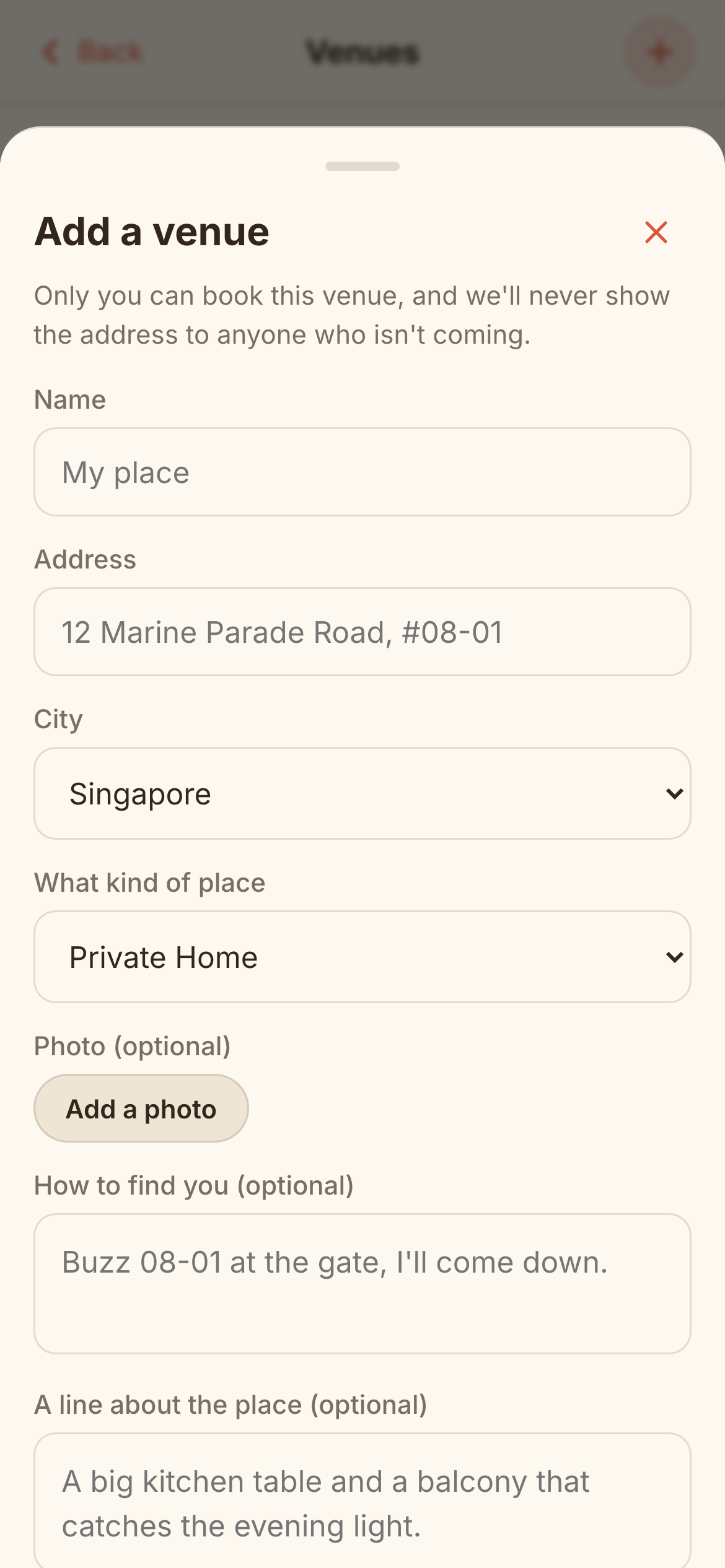
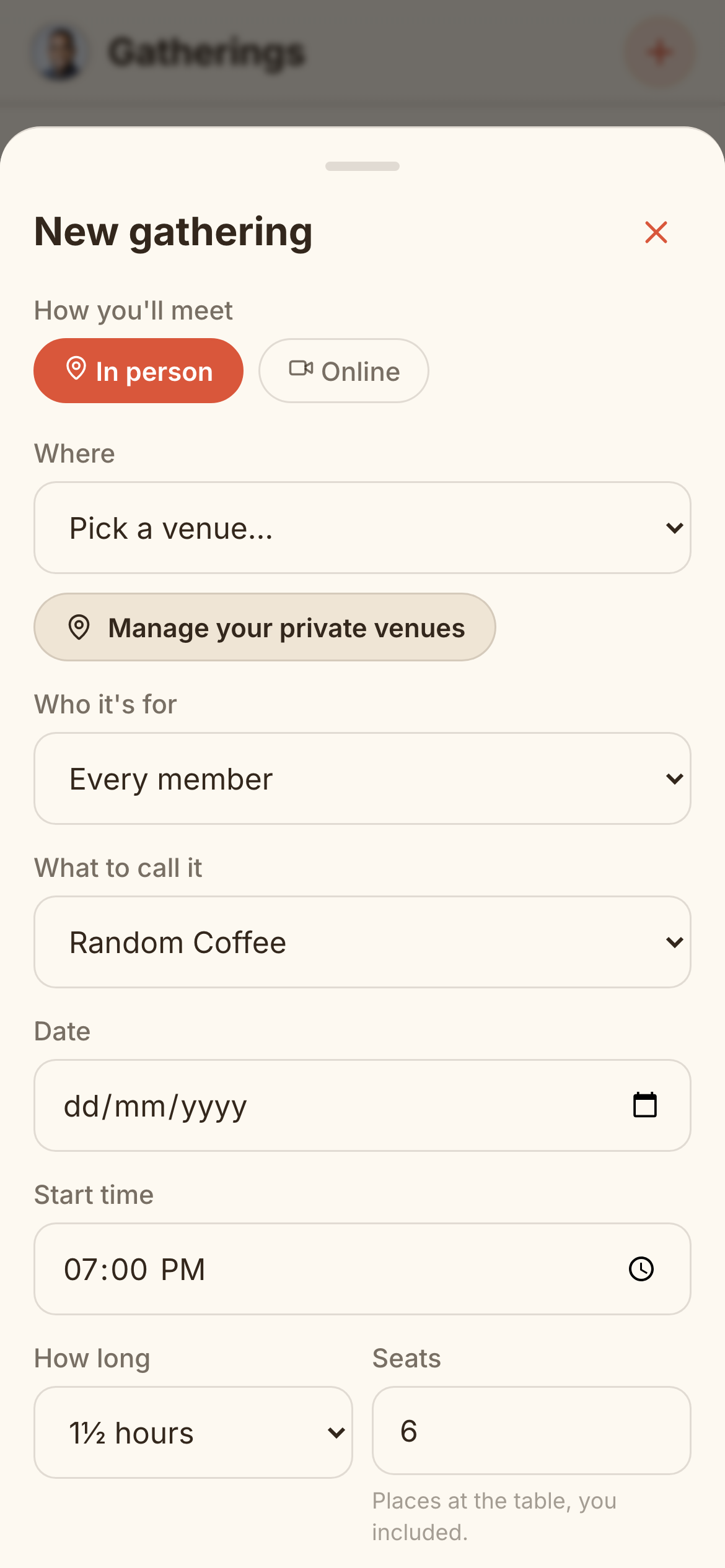
Venue first, because a gathering needs one to point at. Then the gathering
itself.
Reminders are optional and we send our own, so this is a nice-to-have rather
than a duty. That said, a message with somebody's name in it, the day
before, is often the difference between six people and four. If you only do
one optional thing, do this one.
On the day
Get there first.
Ten minutes early
Pick the quietest table
Sit where you can see the door
Order drinks before people arrive (optional)
Hosting in pairs?
One runs the conversation and stays seated. One runs the room: drinks,
late arrivals, the bill, the noisy table next door.
Hosting alone?
Hand the room job to a guest by name before you start. People love
being given a job.
Once the session starts, the primary host does not fetch anything.
The line if you are on your own: "Sarah, would you be my co-host for ten
minutes and make sure everyone's got a drink?" It makes her the second most
comfortable person at the table, which is a gift.
A café that was calm at 3pm can be unusable at 7. If the room is loud, move
to the quietest corner before anybody arrives, and tell us afterwards. We
can change the venue or the time. We cannot hear the room from here.
And do not be late. Five strangers at a table with nobody who knows what
happens next is the worst version of this evening. If it does happen:
message the group, not one person, give a real number of minutes, and name
someone to start the names and the drinks.
If things go wrong
If only one person shows up.
15-20%
cancel at the last minute. Worse at 4 to 7pm.
5%
of gatherings end up with one guest. It's maths, not you.
We keep a standby list to bring that down.
Mark cancellations in the app as soon as you know
Message us in advance if you can see it coming
Buy them a drink, and send us the bill
Do the maths out loud, because it takes the sting out. Last-minute
cancellation runs 15 to 20%, and it is worse for the 4 to 7pm slots when
people are still at work. At those rates, roughly one gathering in twenty
ends up with a single guest. That is arithmetic, not a judgement on you or
your table.
The standby list exists to reduce it, and it works better the earlier we
know. Which is the ask: mark cancellations in the app the moment you hear,
and message us if you can see a thin table coming. We can often fill it.
On the night: run it anyway. With two hosts, one guest is three people, which
is a genuinely lovely evening. Same format, more questions. Do not apologise
more than once, or you turn a small table into a failed one and the guest
starts wondering whether they should have come.
And buy them a drink. Send us the bill, we will sort it. Somebody who turned
up when nobody else did deserves that.
Do not take it personally. Nobody who cancelled was rejecting you.
Your job
Make people feel seen, heard, and loved .
You're the chief encourager, not the guest of honour.
That is the role. Notice, listen, include, guide, connect, and all five are
in service of the one line above.
Chief encourager is the accurate job title. Remember Grant: what separates a
giver at the top from a giver at the bottom is whether anybody encouraged
them to ask. Tonight, that is you.
The host's job is not to be the most interesting person at the table. Which
is why you tell your story last, and why your ask goes last too.
The shape
Ninety minutes.
0-10
Welcome
Drinks, names, seated. Explain what happens. Set the tone.
10-60
Life stories
Five minutes each, in turn. Everyone gets a turn. Yours last.
60-65
The pivot
The importance of asking for help.
65-85
The asks
Everyone. You go last.
85-90
Close
Photo, app, and Fairy Godmothers.
Sixty percent of the evening on stories, forty on the pivot, the asks and
the close. If you are at 70 minutes and have not started the asks, cut a
question, not the second half.
Six people is the target. Four is the minimum, eight is the ceiling, and
hosts count. Ninety minutes, a hundred and twenty at the very most.
Starting: begin when everyone has arrived, or 5 to 10 minutes after the
scheduled time and no later. Waiting punishes the four people who were on
time in order to be polite to the one who was not. The only exception is a
real one, like very heavy rain.
Line to use at ten past: "Let's make a start and we'll catch the others up
when they get here." Latecomers are absorbed easily during stories and
almost impossible to absorb during the asks.
THE WELCOME, which is the two minutes that set everything else up. Four
moves, in your own words: five minutes each in turn; we're more interested
in WHO YOU ARE than what you do; my job is to make sure everyone feels seen,
heard and included; and I'll go last.
The second one is the single most important reframe of the night and it is
what prevents six career summaries. Saying you will go last signals the
evening is not about you, and buys you permission to interrupt people later.
Also ask for phones away.
And do not be at the bar for those two minutes. If you must go, hand over a
person AND a question: "Ben, you're in charge while I grab these. Ask Priya
about the Nepal thing."
Scenario one
Someone won't open up.
Say this
"We'd love to hear more, if you'd like to share."
Extremely common here, because plenty of people are quite sure their own
story is boring. It is not. They have never been asked a good question about
it.
This is where hosting actually happens. Ask, follow up, ask again. Then hand
the question round: half the time somebody else at the table is more curious
than you are and just needs permission.
Note the "if you'd like to share" ending. It gives them a way out, which is
exactly why they take the way in.
Two more that work on absolutely everyone: "if you had to give a TED talk,
what would it be about?" and "what does a normal Tuesday actually look like,
hour by hour?"
And remember what you are asking for. Life stories, not CVs. How they got
here, what they nearly did instead, the bit that went wrong, the person who
changed their mind.
Scenario two
Someone talks too much.
Say this
"I've got so many questions, but I want to make sure we give everyone a
chance to share their story."
The most common problem and the hardest, especially when they are older or
more senior than you. You will get better with practice and you will not get
it perfect tonight.
Interrupt with warmth rather than with a rule. You are not telling them off,
you are so interested that you are worried about running out of time.
Alternative line: "I'm going to pause you there so we can make sure everyone
gets their turn."
Set time out loud at the start and you are keeping a promise rather than
silencing a person. Saying in the welcome that you will go last buys you the
same permission. And turning to the next person by name while still nodding
at the first does most of the work.
Scenario three
Someone gets interrupted.
Say this
"Let's let them finish."
Four words, and they are the whole intervention. Say it lightly, without
looking at the interrupter.
This matters more than it looks. The person interrupted is usually the
quieter one, and if it happens twice they stop offering anything for the rest
of the evening. Protect the floor once early and you rarely have to do it
again.
It also demonstrates the rule to everybody at the table without a lecture.
Scenario four
Someone becomes emotional.
Say this
"Thank you for sharing this with us."
Don't fix. Listen. Thank them. That is the whole intervention.
More often than new hosts expect, because people are telling the story of
their life to strangers who are actually listening.
Do not fix it. Do not offer solutions, do not rush to the next person to
spare them, and do not apologise for the question.
Let the silence sit. "Thank you for sharing this with us" is enough. Then move on
when they are ready rather than when you are comfortable.
The table will follow your lead. If you are calm, they will be calm.
This is the moment somebody feels most seen all year. It is not an
interruption to the format. It is the format working.
Scenario five
Someone gets pushy.
Say this
"That's really interesting. Maybe that's something we can explore after the
session."
Occasionally somebody treats the table as a sales meeting. It happens, and it
does not need a confrontation. Move the pitch out of the room without
rejecting the person.
The same line works for the opposite problem, somebody on their phone all
evening: ask them something only they can answer. Being asked directly is
usually enough.
And hold yourself to the same standard. You should make an ask. You should
not dominate it, and nobody should leave feeling the evening was an excuse to
get something from them. The moment a table suspects that, the format is gone
and it does not come back.
The pivot
Four sentences, in your own words.
People who know a wide range of people do better. Better jobs, better
ideas, more luck.
Granovetter 1973 · Burt 1992
Generous people end up at the top of the pile or the bottom of it. What
separates them is whether they ever ask for anything back.
Grant 2013
Almost everyone here is a giver. We never tell you who is coming, so
nobody turned up tonight to work the room.
Therefore, we all flourish more if everyone asks - so we force everyone
to.
Then open it
"So: one thing this table could help you with. Big or small."
After the stories, before the asks. This is the hinge of the evening and new
hosts skip it, then wonder why the asks feel forced.
Four sentences, about ninety seconds. Steps one and two are the theory, step
three is the bit about us, and step four is the conclusion the room should
reach a beat before you say it. Do not recite the studies. The names are
there so you can answer "says who?" if somebody asks.
Step four used to be "whoever doesn't ask goes home with least", which is a
true sentence aimed at the wrong people. It is an argument about losing out,
and the givers at your table do not move for that; a taker would. Say it as
a rule of the evening instead. "We force everyone to" is doing real work:
nobody has to feel brave if everybody is doing it, and an invitation is
precisely the thing a giver declines politely.
Then go first, and make yours real. A host who asks for something small and
specific gives the table permission. A host who says they are fine has just
shown everyone that opting out is available.
Step three is the one people remember, so land it. Nobody knew who was
coming, which is a filter: the person who wants to work a room does not sign
up for a room they cannot see. So you are sitting with five people who will
all help and none of whom will ask.
Then the invitation, and these lines do real work if you can remember any of
them.
"This can feel a little uncomfortable." Naming it disarms the room and tells
the guess-culture people that everyone finds it hard.
"Big or small: an introduction, advice, an idea, feedback, an opportunity."
"You don't need to know whether anyone here can help. That's the point." This
unlocks the most asks, because the commonest reason people withhold one is
scanning the table, deciding nobody can help, and saying nothing.
"It's okay to ask, and equally okay for someone to say no." Removes the fear
of imposing, which is the actual blocker.
The asks
Push for something specific.
Not an ask
"I'm open to opportunities."
"Just here to learn from everyone."
"Nothing really, I'm good."
"Anyone in tech, really."
An ask
"Anyone who has launched a food product in Malaysia."
"Someone to read my deck before Thursday."
"A physio in the east who is good with knees."
"A friend who runs at 6am, because I never go alone."
Ask twice, then let it go
"That's kind, but I'm going to push you. What would you actually love to
have happen in the next month?"
The left column is a polite exit. Everyone nods, nothing happens.
Push once more. If the second attempt still comes back empty, let it go
warmly and move on. A third push stops being generous and starts being an
interrogation.
The difference between the columns is whether somebody could act on it before
the coffee arrives. "Advice on marketing" gets sympathy. "An introduction to
anyone who has launched a food product in Malaysia" gets a name.
Your ask
Go last. Unless going first would help .
Vulnerability unlocks vulnerability
Keep it brief, and not pushy
Examples
"I moved here two years ago and I still don't have anyone I'd call on
a Sunday."
Default to last, because the evening is not about you and because the table
learns what an ask looks like from four other people first.
But break the rule when the room is stuck. If nobody will go first, or the
first two asks are polite nothings, go next and make yours real.
Vulnerability unlocks vulnerability: it is very hard to be the first person
to admit something, and very easy to be the second.
There is research behind that, and it is the same finding we come back to at
the end. Bruk and colleagues, 2018, the beautiful mess effect: we judge our
own vulnerability far more harshly than other people judge it. From the
inside it feels like weakness. From the outside it looks like courage.
Keep it brief and keep it modest. Hosts who never ask look saintly and break
the format. Hosts who ask for too much lose the table.
If things go wrong
Somebody doesn't pay.
We remind people in advance at non-home venues
You may still need to gently remind them
Discourage alcohol at external venues
If it gets awkward
De-escalate, cover it, and tell us. We'll PayNow you back if it's
reasonable (for now).
Everyone buys their own drink. That is part of the deal and we say so when
people register at a non-home venue.
It still goes wrong occasionally: somebody forgets, or the bill arrives split
oddly, or one person quietly assumes it is hosted. A light touch works:
"shall we settle up at the counter on the way out?"
Discourage alcohol at external venues. It runs the bill up, it changes the
evening, and it makes the settling-up conversation harder than it needs to
be.
If there is any friction at all, do not win the argument. De-escalate, put it
on your card, and tell us. We will PayNow you back if it is reasonable, and
that offer is good at least through August. A host should never be out of
pocket for hosting, and no gathering should end on a row about eight dollars.
05
Part five
Closing, and following up.
The last five minutes
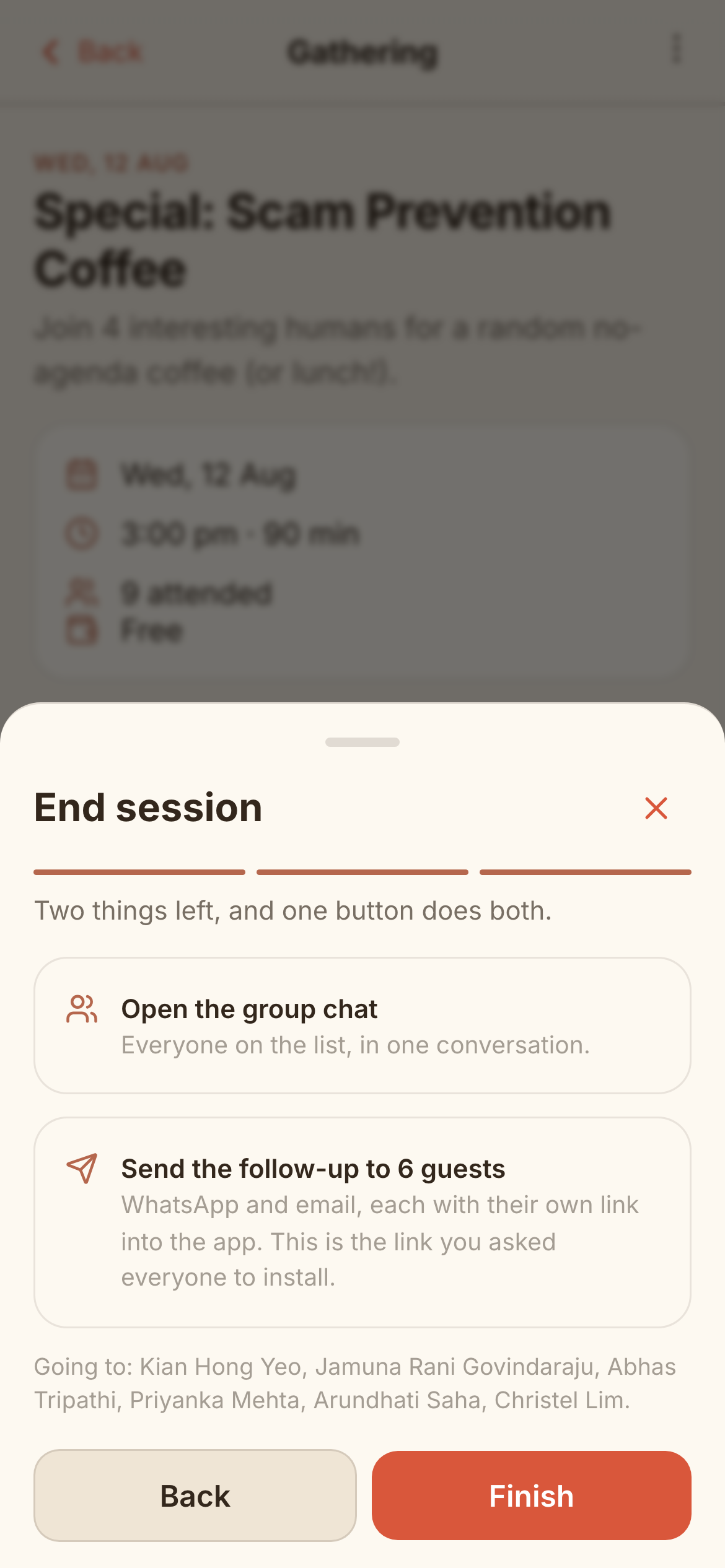
Tap End session.
One button, three things, before you stand up.
This used to be four separate jobs in four separate places, and hosts did
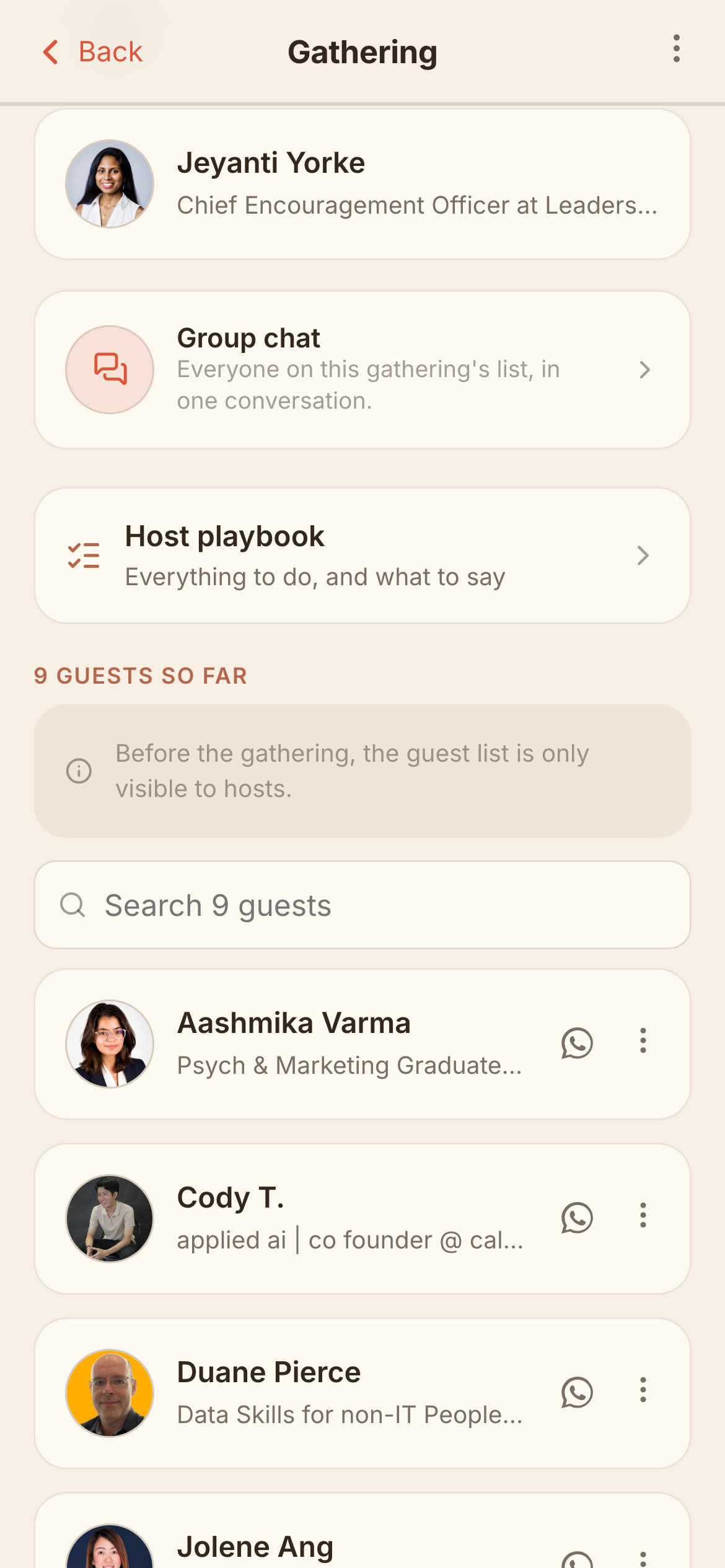
one or two of them. It is one flow now: End session, on the gathering page
or at the bottom of the playbook.
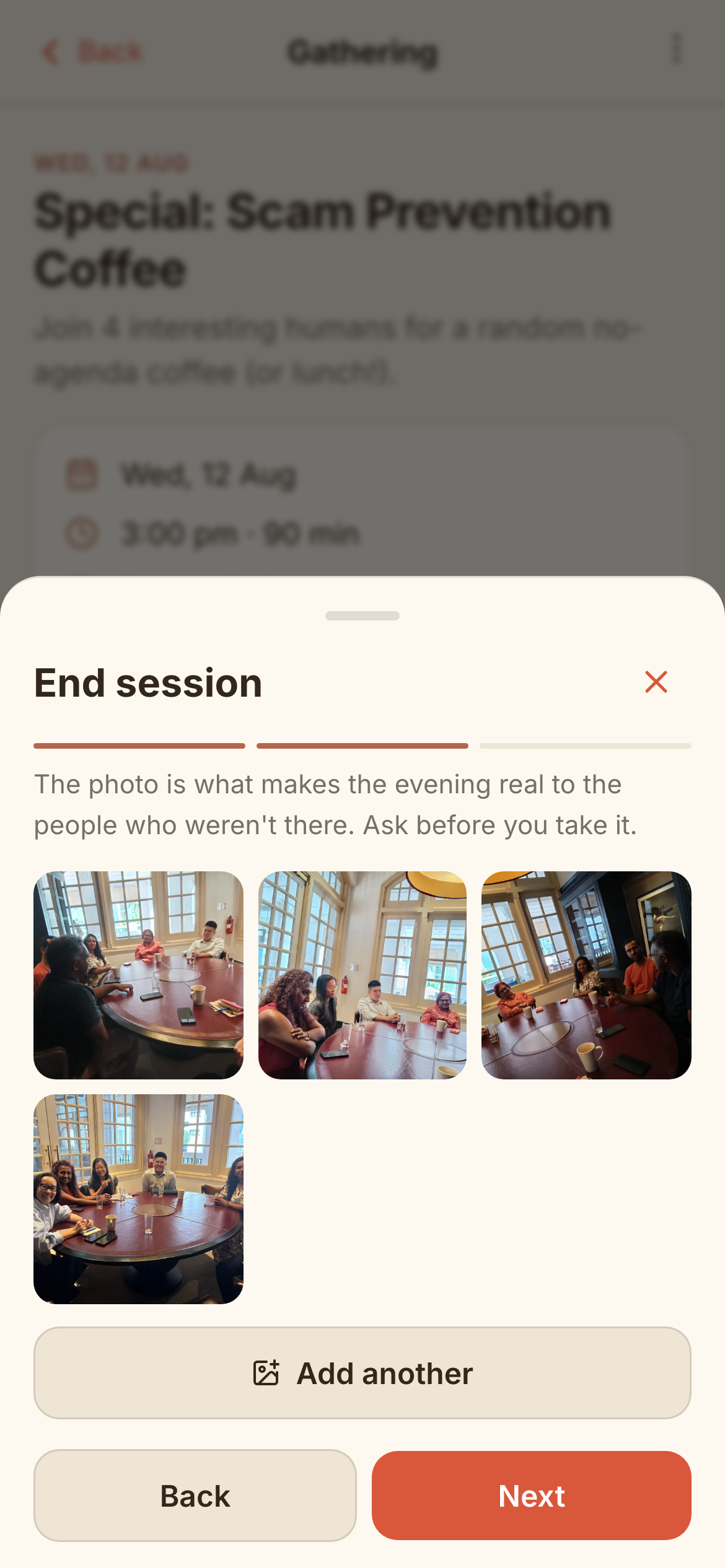
Photo first, before you tap anything. Ask permission, take one. It matters
more than you think, because it is what makes the evening real to the people
who were not there.
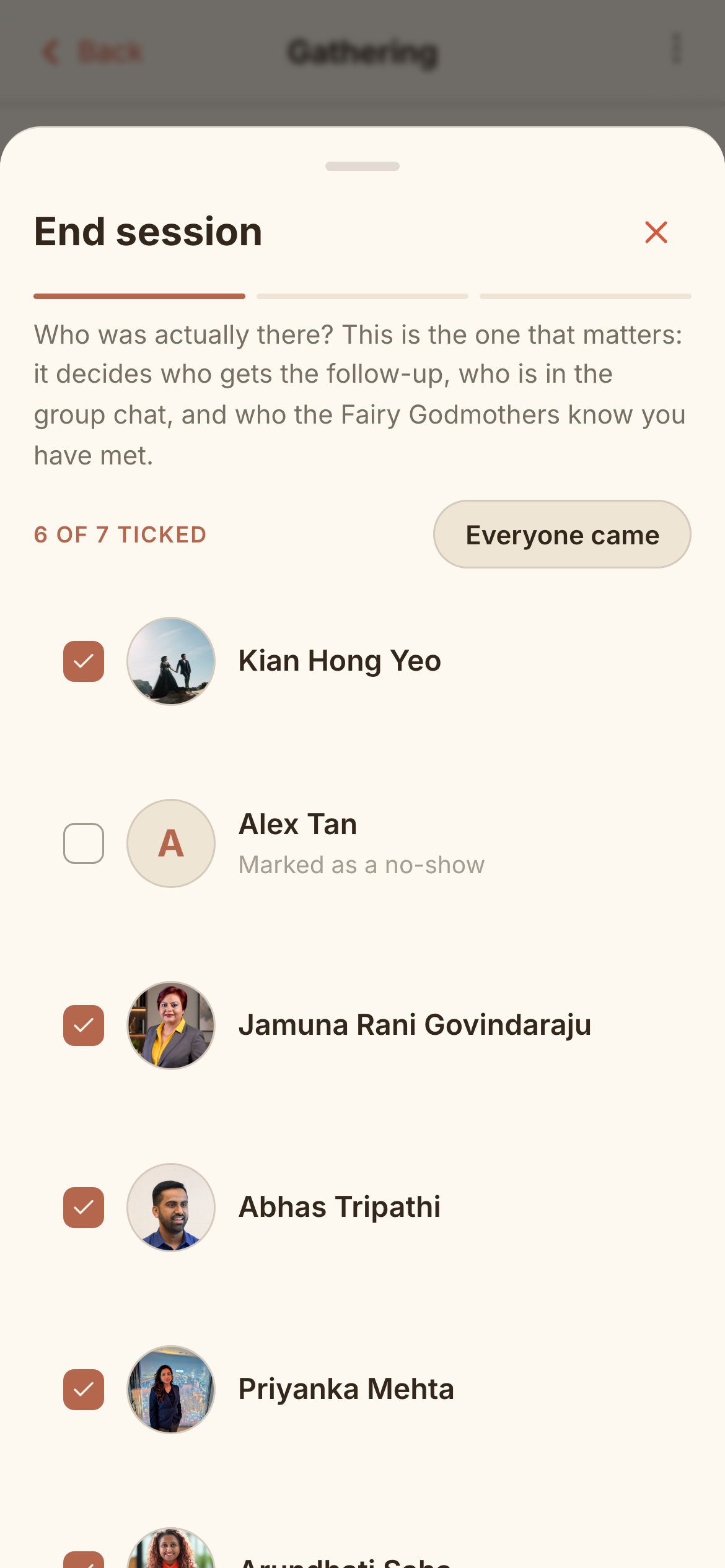
Step one is who actually came, and it is the one that matters. It is what
lets a Fairy Godmother know who met whom, which is what makes reconnect and
the introductions work. A gathering nobody marked is a gathering the system
cannot learn from. It also decides who gets the follow-up and who is in the
chat, so everything else hangs off it.
Finish does the last two: it opens the group chat, and it sends everyone
marked as present the follow-up on WhatsApp and email. That message carries
their own link into the app, so it is also how the app gets installed. It
names the guests before it sends, and it asks first.
Do it at the table. Nobody installs an app from a message the next morning.
Then the last thirty seconds: who do you want to see again, and how often.
Get them to set it before they get home.
The last five minutes
Explaining Fairy Godmothers.
Fairy Godmothers make it easier to connect with people across
sessions.
you
the person you
should meet
Today
you
We Like Humans
Tech gets you 90% of the way - generosity does the rest.
Say roughly this: "Make sure you've shared your ask with your Fairy
Godmother too. She keeps looking across the whole network for people, ideas
or opportunities that might help. You don't have to know who the right
person is. That's partly what she's for."
Do not skip this. One table can only hold six people and this is what turns
one evening into a standing search.
It is also the biggest lever you have on the thing we measure. What people
say out loud is a fraction of what they will tell her in private, and she
cannot work on what she has not been told.
The picture is the one from the start of the session, and it is worth showing
again here, because now they have met each other and it means something. We
hop you to somebody who already knows the person you need. A human makes the
last link. She gets you to the ball; she does not make the prince fall in
love.
If somebody asks whether she reads their asks: yes, that is the whole point,
and nothing is ever public. There is no feed to perform on.
Afterwards
Keep it alive.
not built yet
Record asks soon
not built yet
Review feedback soon
The group chat is already open. End session made it.
Same evening or the next morning, while it is warm.
The chat group used to be a job on this slide. End session opens it, so it
is already there when you get home, and photos go in it. It is in the "…"
menu on the gathering if you need to find it again.
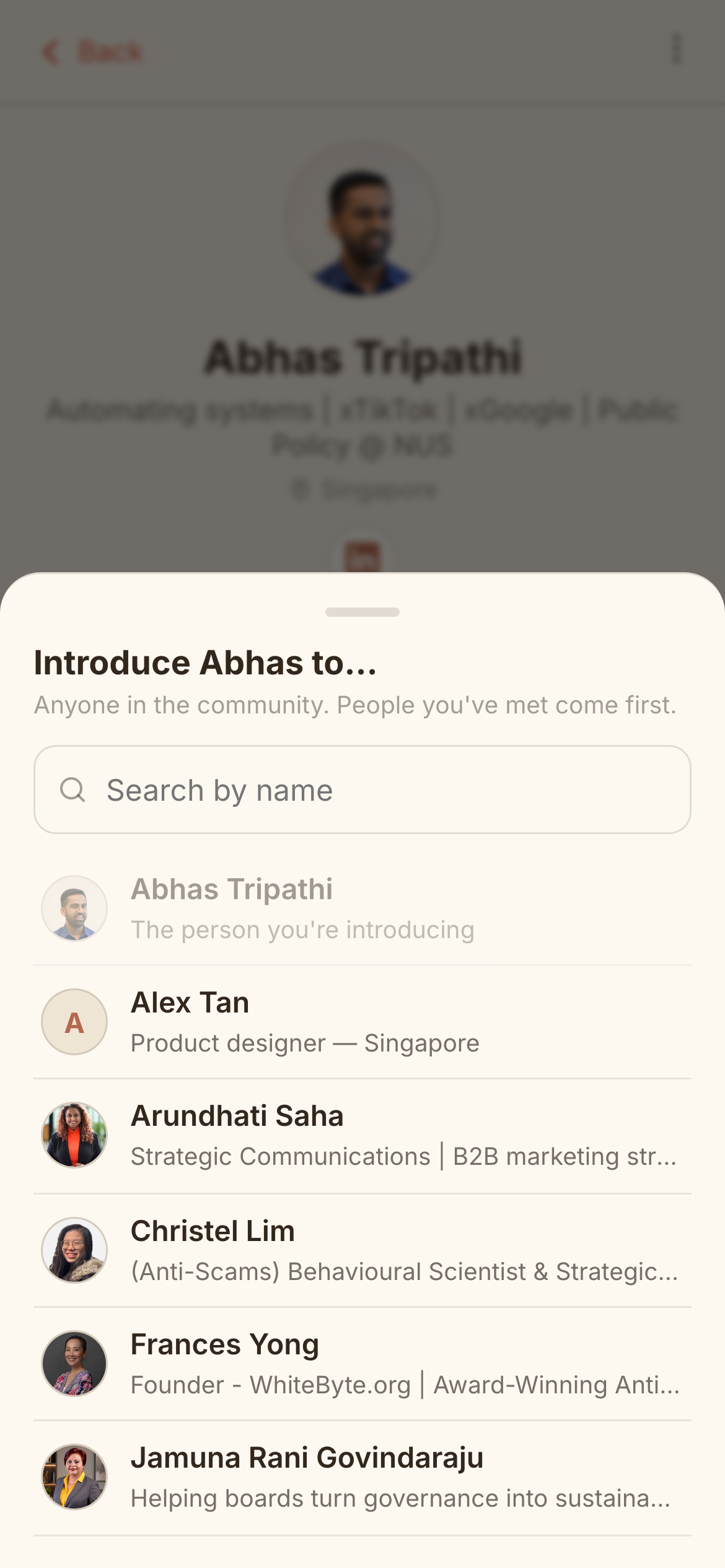
So the only thing left tonight is the introductions. You watched the asks
land. You know which two people should talk again, and you are better placed
than any algorithm to say so tonight. It is on each person's page:
Introduce to…
After every gathering
Three questions.
Did everyone speak?
Did everyone feel included?
Did everyone make an ask?
Ask yourself these on the way home. They are the whole quality check.
If the answer to any of them is no, that is not a failure, it is the thing to
work on next time.
And tell us, especially the no's. A noisy venue or a guest who dominated is
something we can fix for the next host, and only you know about it.
The whole job
Make people feel seen, heard, and loved.
Third time they have heard it, and the last. Everything else in the past
forty minutes is secondary to this, and a host who gets it right can get the
timings wrong all night.
Last thing
Don't worry.
"Even when showing vulnerability might feel more like weakness from the
inside, to others these acts might look more like courage from the
outside."
Bruk, Scholl and Bless , 2018 · the beautiful mess effect
This is the research, and it is better than reassurance.
Bruk and colleagues had people either display vulnerability themselves or
watch somebody else do it. Everyone rated other people's vulnerability far
more positively than their own. They called it the beautiful mess effect.
Which applies directly to you tonight. The fumbled introduction you will
still be thinking about on the way home did not register with anybody else,
or it registered as warmth.
Aronson, 1966, points the same way: a competent person who spills their
coffee becomes more likeable, not less. A polished host makes people sit up
straighter. A host who fumbles something, laughs at themselves and carries on
makes everyone else relax, which is the actual objective.
It is also why we say do not use a script. You cannot fake being interested
in people, and you do not have to fake anything else. Authentic interest is
the one thing we cannot train, and if you volunteered for this you almost
certainly have it.
We Like Humans
Go and host a table.
Message us the moment something goes wrong, or right. Both are useful.
The wrong ones are how the next host gets an easier night. Say that.
And point them at the playbook in the app, on the gathering page. It has
everything from part three onwards, plus the lines to steal, plus End
session at the bottom. Nobody needs to remember this deck.
 We Like Humans